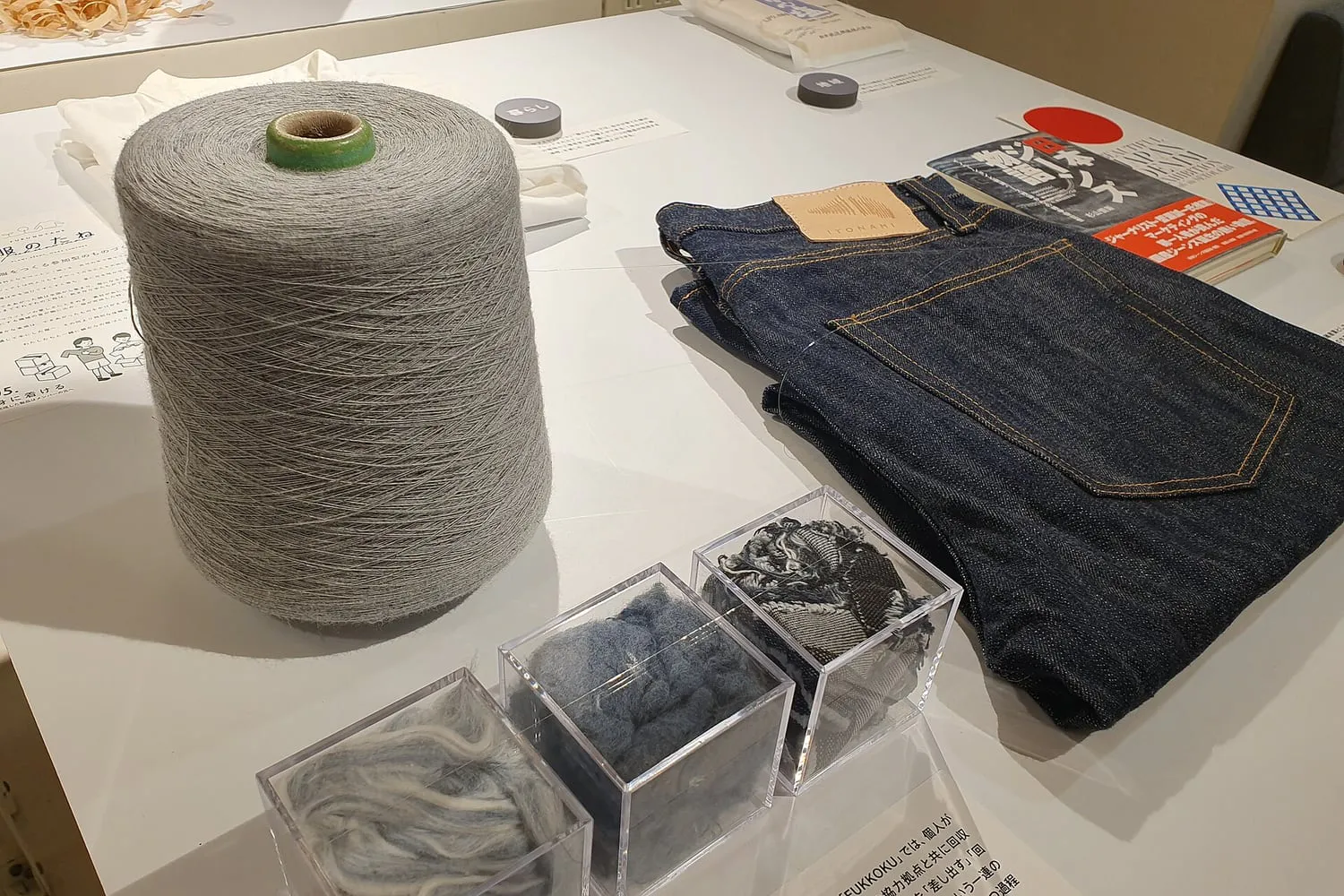
Denim is unusual among vintage clothing because it is built to be legible. The fabric, the seams, the fastenings and the label each change in step with the way the garment was made, so a careful look can place a pair of jeans within a broad period even when you do not recognise the name on the patch.
The important caveat is that age and value are separate questions. Dating tells you when something was made. Value depends on whether anyone wants that particular size, style and condition, and rarity usually comes from the size and the state of the pair rather than from how old it is.
Selvedge and the width of the cloth
The most familiar clue is the selvedge, the finished edge that runs down the inside of the leg seam and stops the fabric fraying. On older denim, the cloth was woven on narrow shuttle looms, and the finished edge was left visible inside the garment rather than hidden. The width of the fabric also shaped how the pattern was laid out, which is why the seams of older jeans sit where they do.
Selvedge alone is not proof of age. Modern mills weave narrow selvedge denim again, and a reproduction will show the same edge as an original. What distinguishes them is the whole assembly around the fabric: the thread, the stitching, the fastenings and the label, which should all point to the same period. When the selvedge says one thing and the label says another, you are looking at either a reproduction or a repaired garment.
Stitching and the inside of the seams
Turn the jeans inside out and read the construction.
- Look at the inner leg seam. A felled seam, where the edges are folded over one another and stitched flat, is the older and more durable method. A serged, overlocked seam that wraps the raw edge is a later and cheaper finish.
- Look at the hem. A chain-stitched hem has a raised, ridged appearance and a distinct line of loops. Chain stitching was standard on older jeans and produces the rippling that enthusiasts look for. A plain lock-stitched hem is more likely to be later, or to be the sign of a hem that has been re-done.
- Look at the thread. Older denim was sewn with cotton thread, which fades and breaks down with washing. Later garments use a thread with a synthetic core that keeps its colour far longer. If the stitching is bright against faded fabric, that threading is probably not original.
- Look at the number of stitch lines along the back yoke and the waistband. Makers changed between single and double rows of stitching over the decades, and the count is one more hint to place beside the others.
Zips, buttons and hardware
The fly is one of the most useful dating points. Older denim was often button-fly, closed with metal shank buttons. When zips took over, they were metal, with the maker’s name or mark stamped onto the pull or the slider, and the fly was cut so a portion of the tape showed. Later, concealed zips became the norm, and plastic or nylon zips appeared alongside them.
Read the zipper pull with a magnifying eye. The mark on the pull, whether the slider body is metal or plastic, and where the metal was finished all move together over time, and a mismatched zip in an otherwise old garment usually means a replacement.
Hardware is the same story. Rivets at the pocket corners, the bar tacks that reinforce the pocket mouths, the buttons on the waistband and the adjustable buckle at the back all changed shape and material with the decades. Look for worn plating, which is normal, and for hardware that has been added later, which shows as a mismatch in colour or age against the surrounding metal.
Labels and printed words
Patches, care labels and printed brand marks are a dense source of clues, but they need to be read as a set. Printed labels, woven labels and paper labels each belong to particular periods. The wording matters as much as the material: instructions about washing, the language of the fibre content, and the way the size is expressed.
One of the most reliable shifts is the presence of a care label at all. Garments made before care labelling became common will often lack one, while a very new care label inside a supposedly old pair is a strong signal that either the label or the garment is not what it appears. Also check the country of origin. The way it is written, the language used and whether it is printed or woven all point to a period, and a stated origin that does not fit the rest of the evidence deserves suspicion.
Rarity comes from size and condition, not from age
A pair of jeans that is genuinely old but cut in a common size and heavily worn may be worth less than a much later pair in a scarce size with little wear. The market rewards the size people are searching for, the wash and fade that is currently in demand, and the condition.
Grade the condition realistically. Fading and wear at the knees and the seat can be desirable as character or fatal as damage depending on the style, but the following reduce value whatever the style: thinning at the crotch, blown-out knees, a waistband that has been stretched, and heavy staining. Repairs done well can be acceptable; repairs disguised as original are not.
Spotting a pair that has been altered
Altered jeans are common and they change both the date and the value, so look for the evidence.
- A hem that is too short or has a different thread colour suggests a cut-off. Removing length also removes the chain-stitched hem, and with it the roping that collectors value.
- A waistband that does not match the rest of the denim, or that sits over a line of old needle holes, suggests the waist has been taken in.
- Legs that taper sharply, or seams that run at an angle rather than straight, suggest a slimmed leg.
- An inner leg seam that has been re-sewn, or a leg seam that shows two stitch lines, suggests the leg was narrowed.
- Patchwork over the seat or thighs can hide damage, so feel for thickness under the patch.
None of this makes a pair worthless, but it should be priced and described as altered rather than original. And remember that the reverse also happens: modern reproductions are sometimes given artificial fading and a cut that mimics an older shape, so treat any single clue as a hint and look for the whole set to agree before you commit. Dating is a matter of the balance of evidence, and value is a separate judgement made afterwards.