A secondhand suit is one of the cheapest credible office wardrobes around, as long as you budget for the tailor as well as the rack. On my rough estimates, nine tailored pieces come to about $272 and the alterations to make them fit about $84: roughly $356 for five work outfits. Treat those as planning numbers, not prices you're guaranteed to find.
Wool tailoring is a category where secondhand buyers often get better construction than they'd buy new at the same money. Floating canvas fronts tend to show up in pricier jackets, and those jackets do land on resale racks for a fraction of the original price.
What to buy, and in what order
Buy in this sequence and you will not end up with four jackets and nothing to wear under them.
- One charcoal wool blazer, $45-65 — Charcoal hides more than black and flatters more skin tones than navy. Single-breasted, notch lapel, only a little room across the back.
- One navy wool blazer, $40-60 — The jacket you wear while the first is at the cleaners. Keep it plain, because brass buttons make it a different garment.
- Two pairs of wool trousers, $22-32 each — One gray, one navy. Flat front, no turn-ups, hem breaking once on the shoe. Wool holds a crease all day; cotton blends do not.
- One wool pencil skirt, $20-30 — The most useful third option in a tailoring wardrobe. Look for a back vent and a lining, and check the zip sits flat.
- Two cotton shirts, $12-18 each — One white, one blue, plain weave with a convertible cuff. Skip anything with a stretch panel: it will not survive a hot iron.
- One merino crewneck, $18-25 — The piece that makes the tailoring wearable in weeks when a shirt alone is too formal or too cold.
- One pair of leather loafers, $35-55 — Buy the sole, not the upper. A resole costs $45; a new upper is impossible. If the leather is worn through at the toe, keep walking.
What a tailor should charge
Treat these as rough estimates for an ordinary city, not quotes. Prices vary a lot by place and by tailor. If you're quoted far above a band, ask why. Far below, and the work may be done without properly opening the garment.
- Waist taken in, trousers (each)
- $18-25
- Waist taken in, pencil skirt
- $15-22
- Jacket taken in at the waist
- $25-40
- Hem shortened, trousers
- $12-20, or nothing if the length is already right
- Sleeve shortened, plain cuff
- $18-25, worth it, unlike the buttoned version
- Sleeve shortened with working buttons
- $30-45, walk away unless the blazer is exceptional
- Replacing a lining
- $50–70, often more than a secondhand jacket costs
- **Total alteration spend**
- About $84 for nine pieces (est.)
Typical alteration costs (estimates)
The math is easy to run before you buy. A $26 trouser plus a $22 alteration is a $48 trouser, still a good deal. An $8 trouser plus the same $22 is a $30 trouser, and it may be worse than the $26 pair you skipped for being gray instead of black.
Five office outfits, costed
The pieces recur, so the totals below are the estimated value of the pieces in each combination, not what you pay again. The outlay is roughly $356, once.
Five office outfits (estimated piece values)
| Outfit | Built from | Price of those pieces |
|---|---|---|
| 1. Charcoal tailoring | Charcoal blazer, gray trousers, white shirt, loafers | $140 |
| 2. Navy on gray | Navy blazer, trousers, blue shirt, loafers | $132 |
| 3. Skirt suit | Charcoal blazer, pencil skirt, white shirt, loafers | $138 |
| 4. Knit and trousers | Merino crewneck, gray trousers, navy blazer, loafers | $140 |
| 5. Warm-weather shirt | White shirt, pencil skirt, loafers | $86 |
Outfit five is the one people forget to plan for. On a hot day the jacket comes off and the outfit has to survive on a shirt, a skirt and shoes, which is the argument for spending on shirts and shoes rather than on a third blazer.
The alteration conversation, in order
- 1
Wear the shoes you will wear with it
Trouser length is meaningless without the heel height. Turning up in flats when you will wear a heel means a second visit.
- 2
Say what you want changed, not what you want done
Tell the tailor the garment pulls across your back or the waist gapes, and let them choose the seam or dart. The reverse conversation produces a jacket that fits but no longer looks like itself.
- 3
Ask for the offcuts
Lengthening a hem later needs matching fabric. A tailor who keeps your offcuts will still have them in two years.
- 4
Insist on a second fitting for anything over $30
Jackets and lined skirts are worth two visits. A shop that will not do a second fitting is not doing real alterations.
- 5
Pay for press and finish
A professional press is the difference between a garment that looks altered and one that looks made for you. Budget a little for it.
What to walk away from
Shiny elbows mean the wool surface has worn, and pressing won't bring it back. Frayed underarm linings mean hard wear in the one spot a tailor can't hide a repair. And check the labels: US rules require a permanently attached care label and a fiber label listing every fiber at 5 percent or more by name and percentage. "100% wool" on that label is a claim you can hold the seller to.
Polyester suits are the other trap. They feel like a bargain, but they don't press as crisply and tend to shine at the knee. Wool is the fiber to look for. Woolmark notes that wool is naturally crease-resistant and doesn't need washing often, which suits a work week.
Where the office pieces come from
Five searches that cover the whole wardrobe. Prices are shown only where we confirmed them on the brand or retailer page in Oct 2026.
Buy firstVintage tailoring
Charcoal wool blazer
Look for a single-breasted cut with a center vent and a full lining. Working cuffs are harder to shorten, so a plain sleeve is the safer buy.
Search listings
Secondhand tailoring
Gray wool flat-front trousers
Flat front, no turn-ups, a hook-and-bar closure. If the seller cannot give you a flat measurement, they do not know whether the trousers fit.
Search listings
Pre-owned shirts
White cotton poplin shirt
Only buy white if the collar is still white. A greyed collar cannot be bleached back without weakening the fabric.
Search listings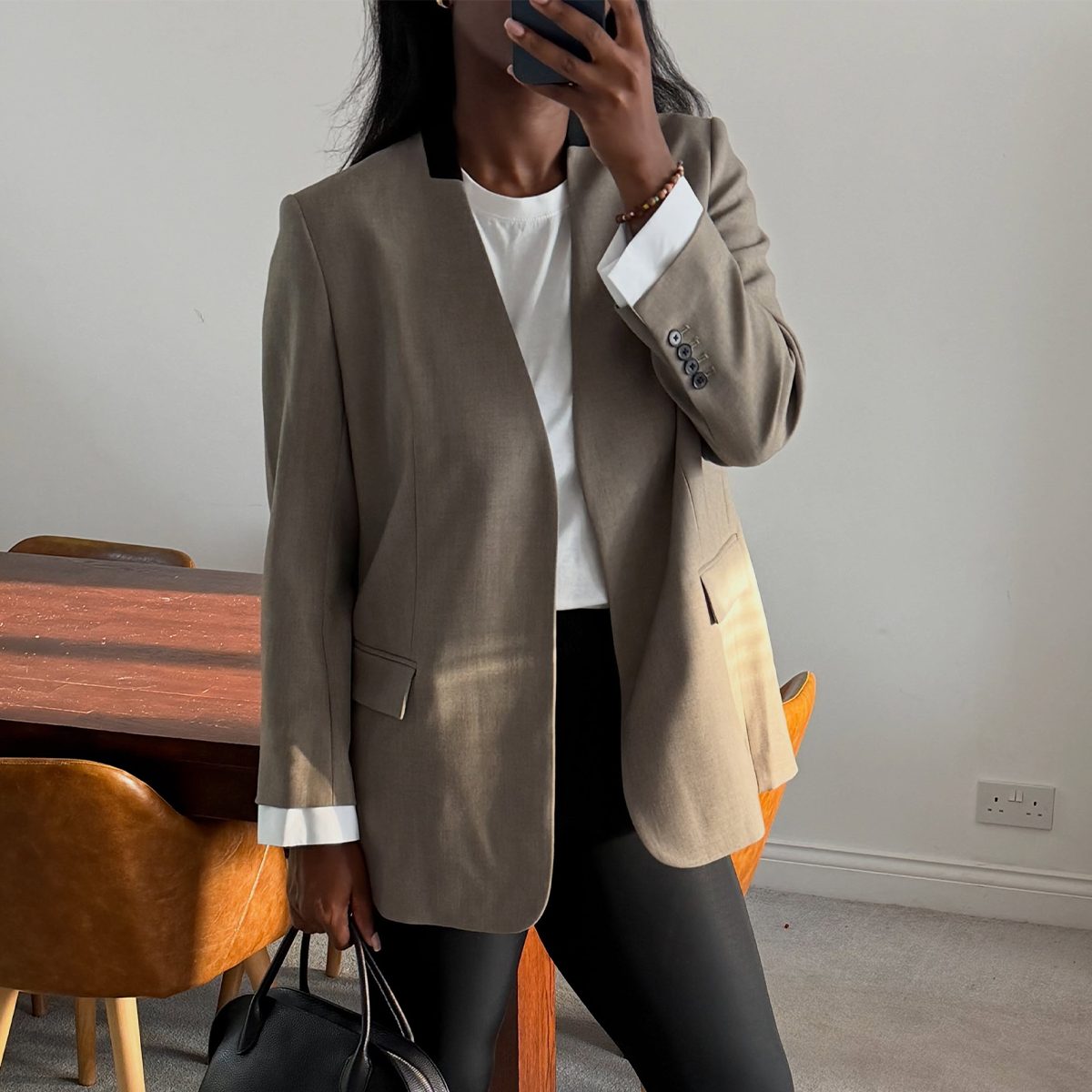 Under the jacket
Fine knitwear
Navy merino crewneck
Fine gauge only, so it layers under a blazer without bunching at the armhole. Merino is the one to look for: Woolmark puts merino fiber at generally under 22 microns, which is why it sits smoothly under tailoring.
Search listings