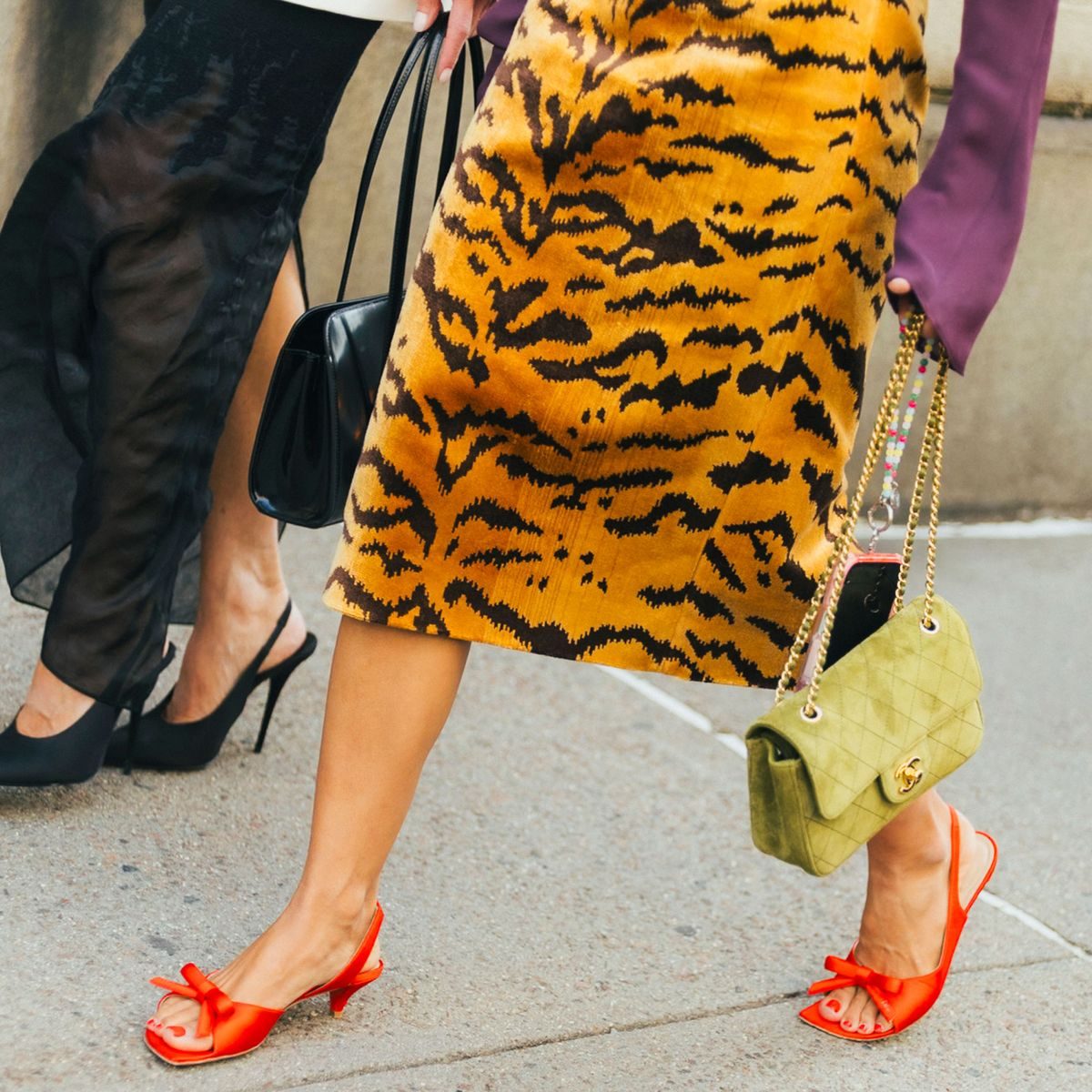
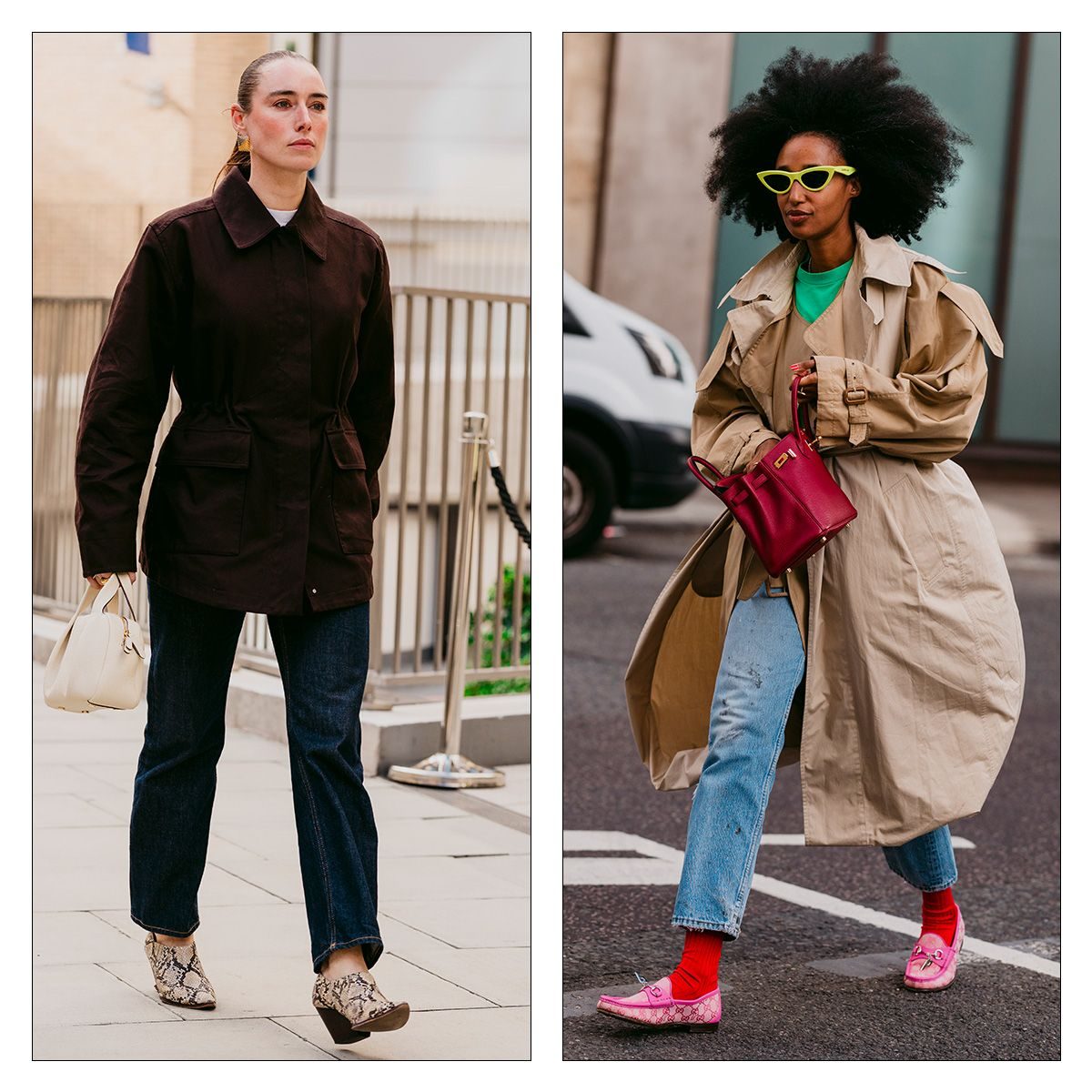
Straight-leg denim tucked into a tall boot solves a problem few combinations solve as cheaply. It lengthens the leg, covers the widest part of the calf, and works most of the year with nothing more than a change of jacket. Bought secondhand, my estimate is that both halves together can come in under $200. For comparison, Frye lists its Campus 12R boot at $498 new (thefryecompany.com, Oct 2026).
The formula has outlasted plenty of trend cycles, and it keeps working for a structural reason. Denim is flat and matte; leather is smooth and catches light. Put them together and the boot reads as a continuation of the leg, not a separate object on the foot. That's why the pairing keeps turning up in street-style photos decade after decade.
Why the proportion holds
A boot that reaches the knee or just below creates one unbroken vertical line from hip to floor. A straight or slightly tapered leg falls into it cleanly, which is the critical detail: a wide leg will bunch at the boot and break the line, and a skinny leg will read as a different decade entirely. The best range is a leg that skims the calf and finishes at the ankle with a break of one to two centimeters.
The second reason is practical. Boots handle weather, uneven pavements and a long walk better than any shoe that flatters the same way. That makes this the one formula you can wear from a school run to a dinner without changing anything but the top half.
- Cowboy boots — A slightly wider shaft and a pointed toe. They add a defined heel, which is the most flattering version of this look and the cheapest to source.
- Knee-high leather boots — A clean shaft and a round toe. Fussier to fit, because the calf measurement matters more than the shoe size, but the stronger option with a long coat.
- Riding boots — Flat-soled and often in better condition secondhand than any other style, because they were bought as practical footwear rather than as fashion.

What both halves cost secondhand
Denim is usually the cheap half and boots are the variable. The ranges below are my estimates for wearable stock as of Oct 2026, and they assume you're willing to buy a boot that needs a reheel.
Denim and boots, typical secondhand prices (estimates, Oct 2026)
| Piece | Typical used (est.) | New, for comparison | The catch |
|---|---|---|---|
| Levi's 501, 1990s | $40–120 | Check levi.com | Check the inner tag and the crotch seams |
| Wrangler 13MWZ | $25–55 | Check wrangler.com | Heavier denim; check the outer leg for fade |
| Any straight-leg denim | $20–45 | Varies widely | Measure the leg opening before buying |
| Cowboy boots | $45–95 | Can run $1,000+ (e.g. Lucchese) | Soles are often worn; budget a reheel |
| Knee-high leather boots | $60–140 | $498 (Frye Campus 12R) | Calf measurement decides whether they work |
| Riding boots, flat | $40–90 | Hundreds new (est.) | Usually the best condition of the three |
| Total | $65–215 | Several hundred and up | Under $200 for the full look is realistic |
What to walk past
On the denim side, the fault to look for doesn't show in a photo: recent stretch denim tends to cling and bunch in a tall boot, and resells poorly. Rigid or near-rigid cotton is what most vintage denim is made of anyway, and it sits better.
Sourcing both halves cheaply
Denim and boots reward patience, because both turn up constantly and some sellers don't know what they have. Set a saved search, set a price ceiling, and let it run for a few weeks. Some brands now run their own resale, too: Frye sells pre-loved pairs on its site, such as a Harness 8R at $159.99 and a Campus 12R at $385 (Oct 2026).
What to set a saved search for
These are search terms worth saving. On both halves, measurement beats label, so ask for the numbers before you pay. Prices are shown only where we confirmed them on the brand or retailer page in Oct 2026.
 Core buy
Levi's
501 straight leg, 1990s
A legible inner tag helps buyers date a pair, which tends to help resale. Keep it intact even if it scratches. Levi Strauss & Co. traces the blue jean to its 1873 rivet patent, and dating a pair is half the fun.
Search listings
Wrangler
13MWZ cowboy cut jean
Heavier denim that breaks in slowly and holds a crease. The higher rise suits a tucked-in shirt, and vintage pairs often cost less than vintage 501s.
Search listings
Vintage leather
Cowboy boots, pointed toe
Check the heel and the toe box for cracks before anything else. Walk away from those.
Search listings
Any maker
Knee-high leather boot
A shaft that's even slightly too narrow won't zip over denim. Ask for the internal calf measurement rather than trusting the size.
Search listings
Any maker
Flat riding boot
Riding boots were made to be used and repaired, so they arrive with replaceable soles more often than fashion boots do. The best value in this list.
Search listingsGetting the fit right on both halves
- 1
Measure the leg opening, not the waist
The leg opening decides if the denim falls neatly into the boot. Ask the seller for the leg opening measurement and compare it with a pair you already own.
- 2
Take the denim to the boot
If you are shopping in person, put the boot on with the denim tucked in before you pay for either. Nothing else predicts how the two behave together.
- 3
Buy the boot half a size down
Leather boots stretch across the instep and the ball of the foot. A boot that fits perfectly in the shop will slide on a long walk.
- 4
Break the denim in dry
Many denim fans wear rigid jeans for a while before the first wash so the creases set the fade. It's the one part of this look that gets better with time.